Artificial intelligence (AI) is no longer just a buzzword; it's an integral part of modern business and society. From automating routine tasks to crafting personalized customer experiences, AI is shaping our world at a breakneck pace. But there isn’t just one AI; there are many different models, all with their strengths and weaknesses. This is where we enter the idea of hybrid AI, which is about synergy. Or the art of blending various AI techniques and models to achieve outcomes that surpass what any single AI approach could accomplish alone.
But why is this approach gaining traction now, and what makes it so special? To answer that, we need to look at the current AI landscape. Generative AI and Large Language Models (LLMs) have been hogging the spotlight recently, and for good reason. These models can generate human-like text, translate languages, and even create art. They're the cool kids on the AI block, wowing us with their ability to engage in seemingly intelligent conversations and tackle complex tasks. However, their power also comes with some weaknesses, which is true for all AI systems.
Limitations Of Generative AI
LLMs, for example, are essentially probabilistic models that generate responses based on patterns in the data they’ve been trained on. This means they don’t “understand” the information in the way humans do – they just predict what’s likely to come next based on their training.
This predictive ability is impressive when it comes to drafting emails, summarizing documents, or even brainstorming creative ideas. However, despite their remarkable capabilities, one of their most significant limitations is their propensity to generate false information with unwavering confidence, a phenomenon often referred to as "hallucination." In many applications, this isn't just a minor inconvenience—it can have serious implications.
The Benefits Of Hybrid Models In Critical Applications
Consider, for instance, the use of a pure generative AI model in healthcare for diagnosing diseases. The potential for inaccuracies could lead to misdiagnoses, inappropriate treatments, or missed critical conditions. In such high-stakes scenarios, we need something more reliable, more precise, and more accountable. This is where Hybrid AI demonstrates its true value.
A Hybrid AI approach in healthcare might combine a traditional machine learning model trained on vast amounts of medical data with a generative AI component. The machine learning model could handle the intricate task of analyzing symptoms, test results, and patient history to generate a diagnosis with a high degree of accuracy. Meanwhile, the generative AI could step in to explain the diagnosis to patients in clear, understandable language, answering questions and providing additional information as needed.
This combination leverages the strengths of both AI types while mitigating their weaknesses. The result? A more accurate diagnosis coupled with better patient communication and understanding. It's a mutually beneficial situation that showcases the power of Hybrid AI.
But healthcare is just one example. Hybrid AI is making waves across various industries. In finance, it's being used to detect fraud more effectively by combining anomaly detection algorithms with natural language processing to analyze transaction patterns and communications. In manufacturing, it's optimizing production lines by merging predictive maintenance models with reinforcement learning algorithms for real-time adjustments.
Hybrid AI Delivers Flexibility And Explainability
The beauty of Hybrid AI lies in its flexibility and adaptability. It's not a one-size-fits-all solution but rather a customizable approach that can be tailored to specific needs and challenges. This adaptability makes it particularly valuable in complex, real-world scenarios where single AI models might fall short.
Another advantage of Hybrid AI is its potential to enhance explainability—a critical factor in building trust in AI systems. While some AI models, particularly deep learning neural networks, can be opaque in their decision-making processes, hybrid approaches often allow for more transparency. This is crucial in regulated industries and in applications where understanding the rationale behind AI decisions is as important as the decisions themselves.
Hybrid AI improves explainability by combining interpretable models with more complex ones, using layered decision-making processes, and providing complementary explanations from various perspectives. This approach offers both high performance and clear explanations.
Consider a Hybrid AI system for loan approvals in the financial sector:
A random forest model analyzes credit scores and financial data.
A deep learning model processes unstructured data like social media activity.
A rule-based system incorporates regulatory requirements.
A logistic regression model combines these outputs for the final decision.
If a loan is denied, the system might explain: "Your application was denied due to a low credit score of 620 and a high debt-to-income ratio of 45%. Recent large purchases detected in your online activity suggest increased risk. Your debt-to-income ratio also exceeds our maximum allowed ratio of 43% as per bank policy."
This multi-faceted explanation is more comprehensive than what a single, complex AI model could provide. It allows applicants to understand the decision and enables regulators to audit the process, ensuring fairness and compliance.
The Future Of Hybrid AI – Potential And Challenges
As we look to the future, the potential of Hybrid AI seems boundless. We're likely to see even more sophisticated combinations of AI models, perhaps integrating quantum computing or neuromorphic technologies. The goal is to create AI systems that are not only more powerful but also more aligned with human reasoning and ethical considerations.
However, it's important to note that Hybrid AI is not without its challenges. Integrating different AI models can be complex, requiring careful design and extensive testing. There's also the question of computational resources—running multiple AI models simultaneously can be demanding. But as technology advances and our understanding deepens, these hurdles are likely to be overcome.
The Dawn Of A New AI Era
As we stand at the dawn of this new AI era, it's clear that Hybrid AI represents more than just a technological advancement—it's a paradigm shift in how we approach problem-solving with artificial intelligence. By combining the best of various AI worlds, we're creating systems that are smarter, more reliable, and better suited to tackle the complex challenges of our time.
The future of AI isn't about choosing between different types of models—it's about bringing them together in harmony. Hybrid AI is leading the charge in this new frontier, promising a future where AI can be both incredibly powerful and trustworthy. As this technology continues to evolve and mature, we can expect to see it playing an increasingly central role in shaping our world, from healthcare and finance to education and beyond.
What is hybrid AI, what elements can you combine and how can it benefit your organisation?
Hybrid AI is a cutting-edge technological approach that combines different types of AI technology to enhance their abilities, performance, versatility and problem-solving.
Rather than relying on a single method, hybrid AI integrates various systems, such as rule-based symbolic reasoning, machine learning and deep learning, to create systems that can reason, learn, and adapt more effectively than AI systems that have not been integrated with others.
This approach not only allows AI systems to leverage the strengths of multiple techniques, enabling more easily interpretable and scalable solutions, but also provides business owners across a variety of fields more accurate insights and increased operational efficiency.
In this article, we’ll address the different types of hybrid AI, the impact hybrid AI has on enhancing customer experiences and the benefits of taking a hybrid AI approach in business.
Types of hybrid AI
To really understand what hybrid AI is, let’s delve into the different types of hybrid AI and what they offer.
Hybrid AI is most often developed by combining two or more types of AI approaches, such as symbolic AI and machine learning, neural networks and knowledge graphs, or deep learning and reinforcement learning.
Each combination offers its own unique benefits, be that improving reasoning abilities, enhancing decision-making or adapting to complicated environments.
Symbolic AI and machine learning
Symbolic AI, which is often referred to as rule-based AI, focuses on using logic and explicit rules to solve problems. It excels in reasoning, structured data processing and interpretability but struggles with handling unstructured data or large-scale problems.
Machine learning (ML), on the other hand, is data-driven and excels at pattern recognition and prediction. It works well when paired with large datasets, identifying trends without needing explicit rules. However, ML models are often difficult to interpret and may struggle with tasks requiring logical reasoning.
Hybrid AI that combines symbolic AI with machine learning makes the most of the reasoning power of symbolic systems as well as the adaptability of machine learning. For instance, a system could use symbolic AI to follow medical guidelines for diagnosing a patient, while machine learning analyses patient records and test results to offer individual recommendations.
Neural networks and knowledge graphs
Neural networks, particularly deep learning models, are considered highly effective at recognising patterns in large datasets like images, text and audio. However, they typically lack the ability to understand and reason about the relationships between those different entities.
Knowledge graphs organise information to provide information on the relationships between concepts, allowing for better reasoning and context. They also provide explanations for how entities are related, making them useful for applications that require contextual awareness.
When combined using hybrid AI, neural networks can process large amounts of unstructured data, while knowledge graphs work to understand the relationships between different data points. This combination enhances decision-making capabilities and allows for a more comprehensive understanding of difficult to interpret data.
For example, in customer support systems, neural networks might analyse customer interactions, while a knowledge graph can provide context about customer preferences and previous issues to offer better solutions.
Deep learning and reinforcement learning
Deep learning systems are excellent at extracting patterns from large datasets but typically require significant amounts of training data to perform well.
In contrast, reinforcement learning (RL), involves learning from interactions with an environment by receiving rewards or penalties based on actions taken. However, this type of programme can struggle when there’s too much complexity without guidance.
When taking a hybrid approach, deep learning can be used to analyse the environment and detect relevant patterns, while reinforcement learning enables the system to learn optimal strategies through trial and error.
For example, deep learning might help a robot identify objects, while reinforcement learning helps it learn how to interact with those objects in a way that maximises its performance on a task.
Example applications of hybrid AI
Hybrid AI is already being used in a number of fields to combine different capabilities for better business outcomes and customer experience.
And, while there are many examples of this type of AI at play, here are some prominent examples:
Healthcare: When it comes to medical diagnostics, hybrid AI systems can combine machine learning models (which analyse medical images) with symbolic reasoning (which follows clinical guidelines) to offer more accurate diagnoses to patients in need.
Finance: In fraud detection, hybrid AI systems can combine rule-based approaches (which ensure compliance with regulatory standards) and machine learning (which detects suspicious patterns in transactions).
Autonomous systems: Self-driving cars use hybrid AI by combining symbolic systems for safe driving rules with machine learning for the detection of objects like pedestrians or other vehicles on the road.
Benefits of hybrid AI
Now that we’ve explained what hybrid AI is and the impact it’s having on important sectors, you’ll be unsurprised to learn that this approach offers several distinct advantages over traditional single-method AI systems:
Enhanced accuracy: By combining different AI techniques, hybrid systems can achieve higher accuracy and performance.
Improved interpretability: Symbolic AI systems provide greater transparency and explainability.
Flexibility and adaptability: Hybrid AI systems can handle a broader range of tasks and adapt to complex environments more easily.
Robustness: Hybrid AI systems are more resilient to errors, as different methods can compensate for the weaknesses of others.
Better decision-making: By incorporating both data-driven learning and explicit reasoning, hybrid AI enables more informed and context-aware decision-making, particularly in areas where safety or compliance is essential.
In summary, hybrid AI represents the next evolution in artificial intelligence by combining multiple techniques to create more powerful, flexible and reliable systems. By integrating methods like symbolic reasoning, machine learning, and reinforcement learning, hybrid AI is driving innovation in diverse fields such as healthcare, finance, autonomous systems and more.
Also:
What is hybrid AI?
| The 'New World Order' |
|
.jpg)
Why Hybrid AI Is The Next Big Thing In Tech
What Is Space? It’s not what you think.
Ask a group of physicists and philosophers to define “space” and you will likely be stuck in a long discussion that involves deep-sounding but meaningless word combinations such as “the very fabric of space-time itself is a physical manifestation of quantum entropy concepts woven together by the universal nature of location.” On second thought, maybe you should avoid starting deep conversations between philosophers and physicists.
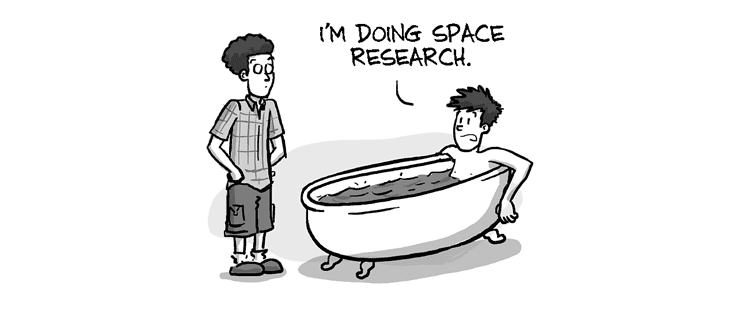
Is space just an infinite emptiness that underlies everything? Or is it the emptiness between things? What if space is neither of these but is a physical thing that can slosh around, like a bathtub full of water?
It turns out that the nature of space itself is one of the biggest and strangest mysteries in the universe. So get ready, because things are about to get ... spacey.
Space, It’s a Thing
Like many deep questions, the question of what space is sounds like a simple one at first. But if you challenge your intuition and reexamine the question, you discover that a clear answer is hard to find.
Most people imagine that space is just the emptiness in which things happen, like a big empty warehouse or a theater stage on which the events of the universe play out. In this view, space is literally the lack of stuff. It is a void that sits there waiting to be filled, as in “I saved space for dessert” or “I found a great parking space.”
If you follow this notion, then space is something that
can exist by itself without any matter to fill it. For example, if you
imagine that the universe has a finite amount of matter in it, you could
imagine traveling so far that you reach a point beyond which there is
no more stuff and all the matter in the universe is behind you.1
You would be facing pure empty space, and beyond that, space might
extend out to infinity. In this view, space is the emptiness that
stretches out forever.
Could Such a Thing Exist?
That picture of space is reasonable and seems to fit with our experience. But one lesson of history is that anytime we think something is obviously true (e.g., the Earth is flat, or eating a lot of Girl Scout cookies is good for you), we should be skeptical and take a step back to examine it carefully. More than that, we should consider radically different explanations that also describe the same experience. Maybe there are theories we haven’t thought of. Or maybe there are related theories where our experience of the universe is just one weird example. Sometimes the hard part is identifying our assumptions, especially when they seem natural and straightforward.
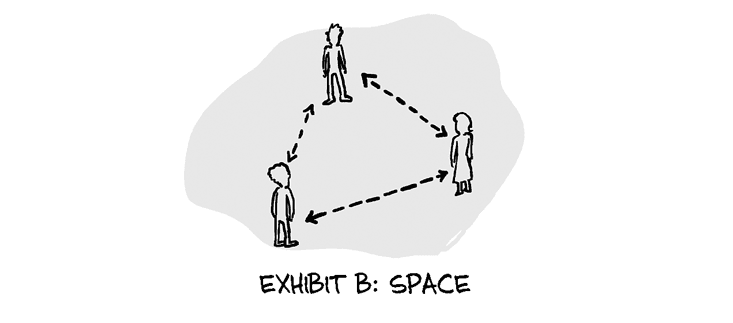
In this case, there are other reasonable-sounding ideas for what space could be. What if space can’t exist without matter—what if it’s nothing more than the relationship between matter? In this view, you can’t have pure “empty space” because the idea of any space at all beyond the last piece of matter doesn’t make any sense. For example, you can’t measure the distance between two particles if you don’t have any particles. The concept of “space” would end when there are no more matter particles left to define it. What would be beyond that? Not empty space.
That is a pretty weird and counterintuitive way of
thinking about space, especially given that we have never experienced
the concept of non-space. But weird never stood in the way of physics,
so keep an open mind.
Which Space Is the Place?
Which of these ideas about space is correct? Is space like an infinite void waiting to be filled? Or does it only exist in the context of matter?
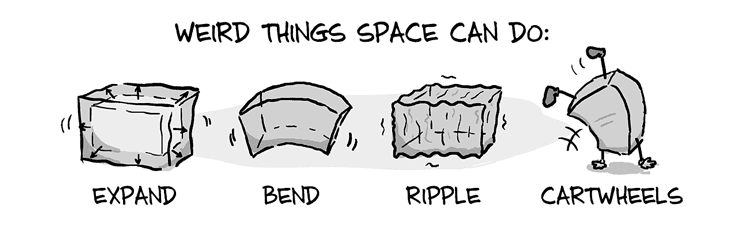
It turns out that we are fairly certain that space is neither of these things. Space is definitely not an empty void and it is definitely not just a relationship between matter. We know this because we have seen space do things that fit neither of those ideas. We have observed space bend and ripple and expand.
This is the part where your brain goes, “Whaaaaat ... ?”
If you are paying attention, you should be a little confused when you read the phrases “bending of space” and “expanding of space.” What could that possibly mean? How does it make any sense? If space is an idea, then it can’t be bent or expanded any more than it can be chopped into cubes and sautéed with cilantro.2 If space is our ruler for measuring the location of stuff, how do you measure the bending or expanding of space?
Good questions! The reason this idea of space bending is so confusing is that most of us grow up with a mental picture of space as an invisible backdrop in which things happen. Maybe you imagine space to be like that theater stage we mentioned before, with hard wooden planks as a floor and rigid walls on all sides. And maybe you imagine that nothing in the universe could bend that stage because this abstract frame is not part of the universe but something that contains the universe.
Unfortunately, that is where your mental picture goes
wrong. To make sense of general relativity and think about modern ideas
of space, you have to give up the idea of space as an abstract stage and
accept that it is a physical thing. You have to imagine that
space has properties and behaviors, and that it reacts to the matter in
the universe. You can pinch space, squeeze it, and, yes, even fill it
with cilantro.3
At this point, your brain might be sounding “what the #@#$?!?!” nonsense alarms. That is totally understandable. Prepare to bear with us, because the real craziness is yet to come. Your nonsense alarms will be exhausted by the time we’re done. But we need to unpack these concepts carefully to understand the ideas here and appreciate the truly strange and basic mysteries about space that remain unanswered.
Space Goo, You’re Swimming in It
How can space be a physical thing that ripples and bends, and what does that mean?
It means that instead of being like an empty room (a really big room) space is more like a huge blob of thick goo. Normally, things can move around in the goo without any problems, just like we can move around a room full of air without noticing all the air particles. But under certain circumstances, this goo can bend, changing the way that things move through it. It can also squish and make waves, changing the shape of the things inside it.

This goo (we’ll call it “space goo”) is not a perfect
analogy for the nature of space, but it’s an analogy that helps you
imagine that the space you are sitting in right now at this moment is
not necessarily fixed and abstract.4 Instead, you are sitting in some concrete thing, and that thing can stretch or jiggle or distort in ways that you may not be perceiving.
Maybe a ripple of space just passed through you. Or maybe we are being stretched in an odd direction at this moment and don’t even know it. In fact, we didn’t even notice until recently that the goo did anything but sit there, goo-ing nowhere, which is why we confused it with nothingness.
So what can this space goo do? It turns out it can do a lot of weird things.
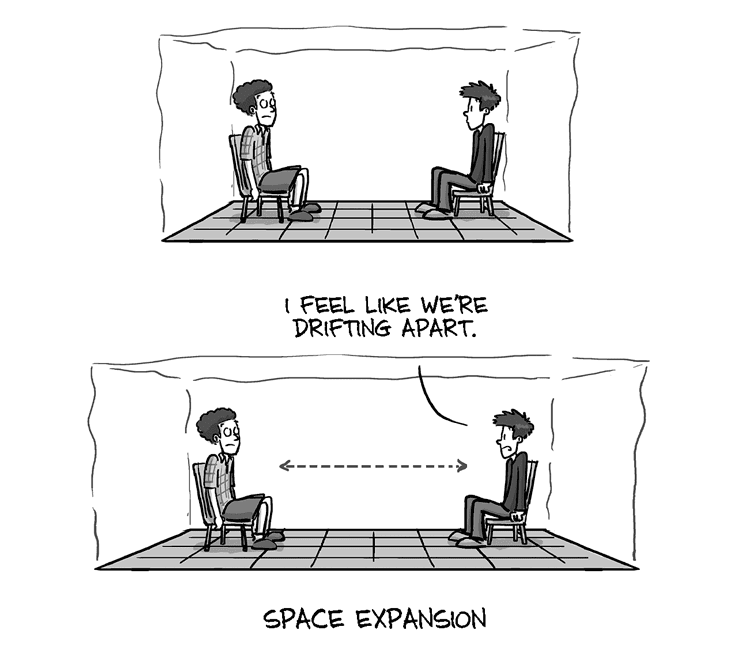
First, space can expand. Let’s think carefully for a minute about what it means for space to expand. That means things get farther apart from each other without actually moving through the goo. In our analogy, imagine that you are sitting in the goo, and suddenly the goo started growing and expanding. If you were sitting across from another person, that person would now be farther away from you without either of you having moved relative to the goo.
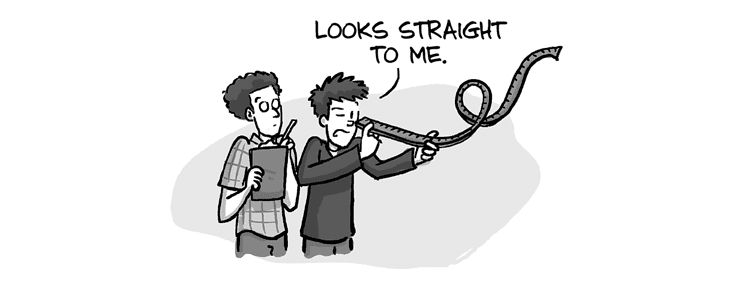
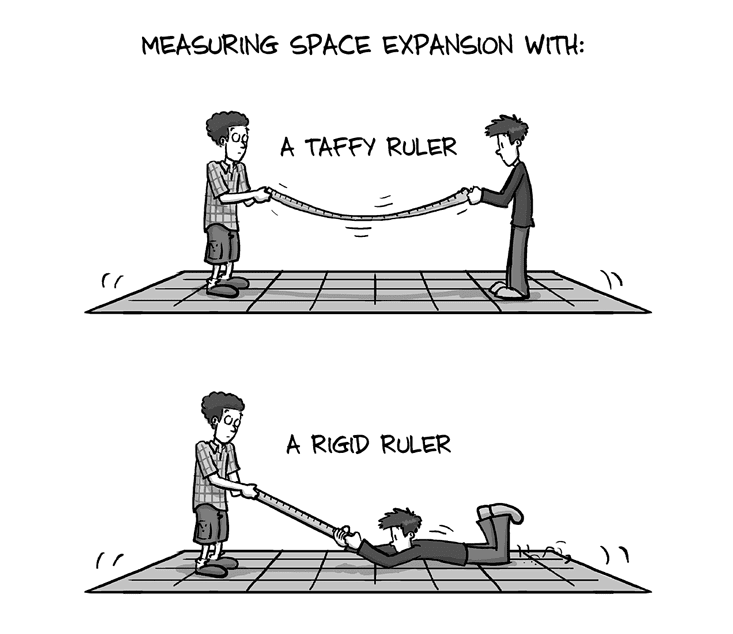
How could we know that the goo expanded? Wouldn’t a ruler we use to measure the goo also
expand? It’s true that the space between all the atoms in the ruler
would expand, pulling them apart. And if our ruler was made out of
extra-soft taffy, it would also expand. But if you use a rigid ruler,
all of its atoms would hold on to one another tightly (with
electromagnetic forces), and the ruler would stay the same length,
allowing you to notice that more space was created.
And we know that space can expand because we have seen it expanding—this is how dark energy was discovered. We know that in the early universe space expanded and stretched at shocking rates, and that a similar expansion is still happening today.
We also know that space can bend. Our goo can be
squished and deformed just like taffy can. We know this because in
Einstein’s theory of general relativity that’s what gravity is: the
bending of space.5 When something has mass, it causes the space around it to distort and change shape.
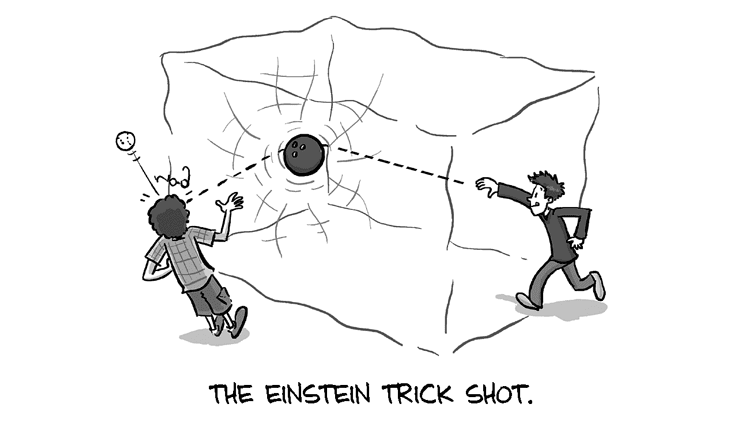
When space changes shape, things no longer move through it the way you might first imagine. Rather than moving in a straight line, a baseball passing through a blob of bent goo will curve along with it. If the goo is severely distorted by something heavy, like a bowling ball, the baseball might even move in a loop around it—the same way the moon orbits the Earth, or the Earth orbits the sun.
And this is something we can actually see with our naked eyes! Light, for example, bends its path when it passes near massive objects like our sun or giant blobs of dark matter. If gravity was just a force between objects with mass—rather than the bending of space—then it shouldn’t be able to pull on photons, which have no mass. The only way to explain how light’s path can be bent is if it’s the space itself that is bending.
Finally, we know that space can ripple. This is
not too far-fetched given that we know that space can stretch and bend.
But what is interesting is that the stretching and bending can propagate
across our space goo; this is called a gravitational wave. If you cause
a sudden distortion of space, that distortion will radiate outward like
a sound wave or a ripple inside of a liquid. This kind of behavior
could only happen if space has a certain physical nature to it and is
not just an abstract concept or pure emptiness.
We know this rippling behavior is real because (a) general relativity predicts these ripples, and (b) we have actually sensed these ripples. Somewhere in the universe, two massive black holes were locked in a frenzied spin around each other, and as they spun, they caused huge distortions in space that radiated outward into space. Using very sensitive equipment, we detected those space ripples here on Earth.
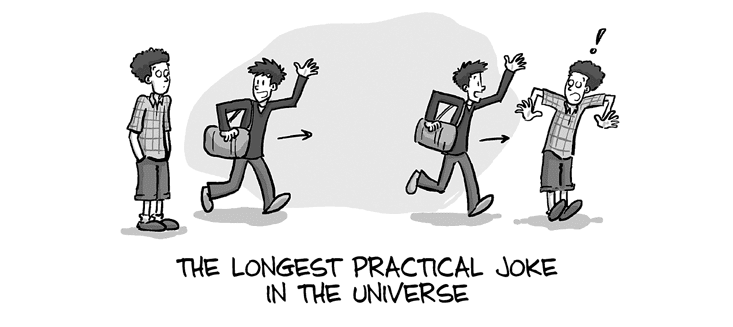
You can think of these ripples as waves of space stretching and compressing. Actually, when a space ripple passes through, space shrinks in one direction and expands in another direction.
This Sounds Ridic-goo-lous. Are You Sure?
As crazy as it may sound that space is a thing and not just pure emptiness, this is what our experience of the universe tells us. Our experimental observations make it pretty clear that the distance between objects in space is not measured on an invisible abstract backdrop but depends on the properties of the space goo in which we all live, eat cookies, and chop cilantro.
But while thinking of space as a dynamic thing with physical properties and behaviors might explain weird phenomena like space bending and stretching, it only leads to more questions.
For example, you might be tempted to say that what we used to call space should now be called physics goo (“phgoo”) but that this goo has to be in something, which we could now call space again. That would be clever, but as far as we know (which to date is not very far), the goo does not need to be in anything else. When it bends and curves, this is intrinsic bending that changes the relationships between parts of space, not the bending of the goo relative to some larger room that it fills.
But just because our space goo doesn’t need to sit inside of something else doesn’t mean that it is not sitting inside something else. Perhaps what we call space is actually sitting inside some larger “superspace.”6 And perhaps that superspace is like an infinite emptiness, but we have no idea.
Is it possible to have parts of the universe without space? In other words, if space is a goo, is it possible for there to be not-goo, or the absence of goo? The meaning of those concepts is not very clear because all of our physical laws assume the existence of space, so what laws could operate outside of space? We have no idea.
The fact is that this new understanding of space as a
thing has come recently, and we are at the very beginning of
understanding what space is. In many ways, we are still hobbled by our
intuitive notions. These notions served us well when early men and women
were hunting for game and foraging for prehistoric cilantro, but we
need to break the shackles of these concepts and realize that space is
very different from what we imagined.
Straight Thinking about Bent Space
If your brain is not yet hurting from all these gooey space-bending concepts, here is another mystery about space: Is space flat or curved (and if it’s curved, which way does it curve)?
These are crazy questions, but they are not
that hard
to ask once you accept the notion
that space is malleable. If space can
bend around
objects with mass, could it have an overall curvature to
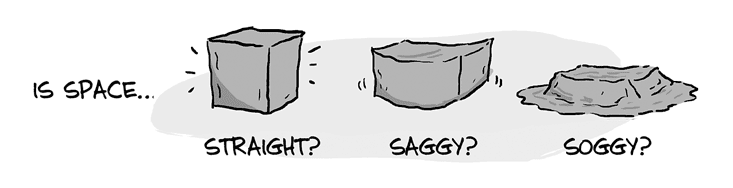
it? It’s like asking if our goo is flat: You know that it can jiggle and
deform if you push any point on it, but does it sag overall? Or does it
sit perfectly straight? You can ask these questions about space, too.
Answering these questions about space would have an
enormous impact on our notion of the universe. For example, if space is
flat, it means that if you travel in one direction forever you could
just keep going, possibly to infinity.
But if space is curved, then other interesting things might happen. If space has an overall positive curvature, then going off in one direction might actually make you loop around and come back to the same spot from the opposite direction! This is useful information if, for example, you don’t like the idea of people sneaking up behind you.
Explaining the idea of curved space is very difficult
because our brains are simply not well equipped to visualize concepts
like these. Why would they be? Most of our everyday experience (like
evading predators or finding our keys) deals with a three-dimensional
world that seems pretty fixed (although if we are ever attacked by
advanced aliens that can manipulate the curvature of space, we hope we,
too, can figure it out quickly).
What would it mean for space to have a curvature? One way to visualize it is to pretend for a second that we live in a two-dimensional world, like being trapped in a sheet of paper. That means we can only move in two directions. Now, if that sheet we live in lies perfectly straight, we say that our space is flat.
But if for some reason that sheet of paper is bent, then we say that the space is curved.
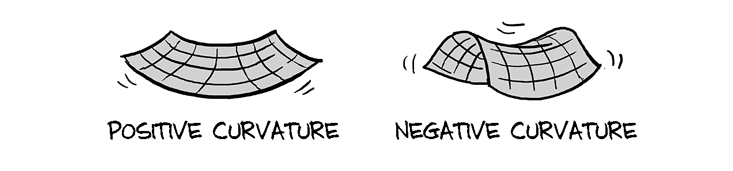
And there are two ways that the paper can be bent. It
can all be curved in one direction (called “positive curvature”) or it
can be bent in different directions like a horse saddle or a Pringles
potato chip (this is called “negative curvature” or “breaking your
diet”).
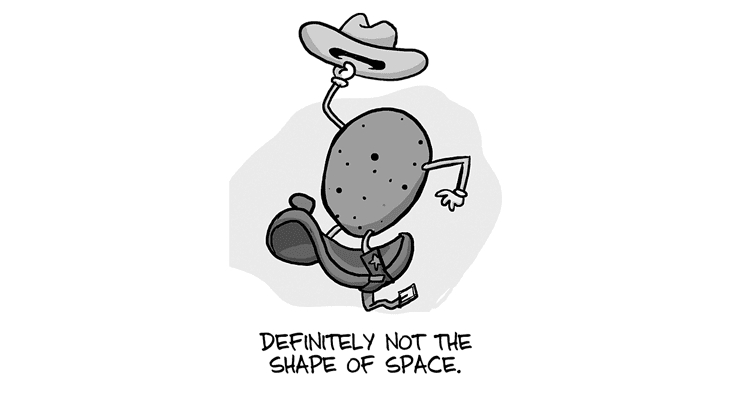
Here is the cool part: if we find out that space is flat everywhere, it means that the sheet of paper (space) could potentially go on forever. But if we find out that space has a positive curvature everywhere, then there’s only one shape that has positive curvature everywhere: a sphere. Or to be more technical, a spheroid (i.e., a potato). This is one way in which our universe could loop around itself. We could all be living in the three-dimensional equivalent of a potato, which means that no matter which direction you go you end up coming back around to the same spot.
In this case, it turns out that we do have an answer,
which is that space does appear to be “pretty flat,” as in space is
within 0.4 percent of being flat. Scientists, through two very different
methods, have calculated that the curvature of space (at least the
space we can see) is very nearly zero.
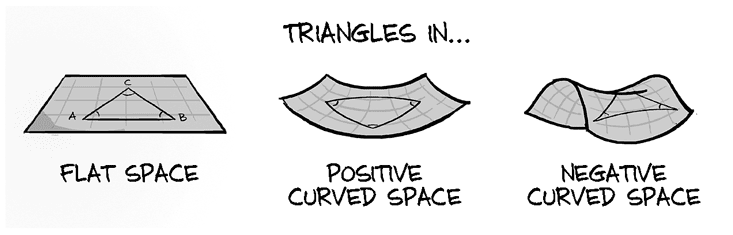
What are these two ways? One of the ways is by measuring triangles. An interesting thing about curvature is that triangles in a curved space don’t follow the same rules as triangles in flat space. Think back to our sheet-of-paper analogy. A triangle drawn on a flat sheet of paper is going to look different than a triangle drawn on a curved surface.
Scientists have done the equivalent of measuring
triangles drawn in our three-dimensional universe by looking at a
picture of the early universe and studying the spatial relationship
between different points on that picture. And what they found was that
the triangles they measured correspond to those of flat space.
The other way in which we know that space is basically flat is by looking at the thing that causes space to curve in the first place: the energy in the universe. According to general relativity, there is a specific amount of energy in the universe (energy density, actually) that will cause space to bend in one direction or the other. It turns out that the amount of energy density that we can measure in our universe is exactly the right amount needed to cause the space that we can see to not bend at all (within a margin of error of 0.4 percent).
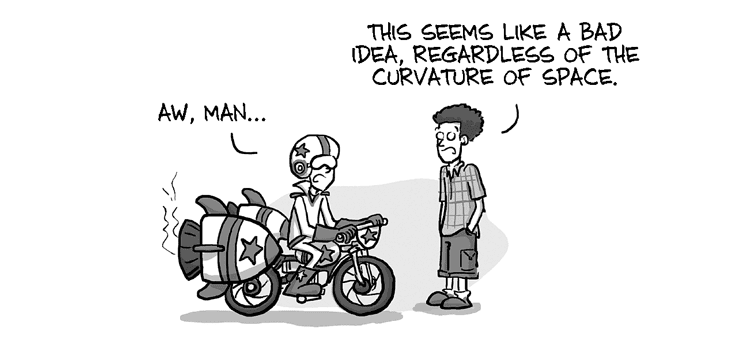
Some of you might be disappointed to learn we don’t live in a cool three-dimensional cosmic potato that loops around if you go in one direction forever. Sure, who hasn’t dreamed of doing Evel Knievel–style spins around the entire universe on a rocket motorcycle? But instead of feeling disappointed by the fact that we live in a boring flat universe, you might want to be a little intrigued. Why? Because as far as we know, the fact that we live in a flat universe is a gigantic cosmic-level coincidence.
Think about it. All the mass and energy in the universe
is what gives space its curvature (remember that mass and energy distort
space), and if we had just a little bit more mass and energy than we
have right now, space would have curved one way. And if we had just a
little bit less than we have right now, space would have curved the
other way. But we seem to have just the right amount to make
space perfectly flat as far as we can tell. In fact, the exact amount is
about five hydrogen atoms per cubic meter of space. If we had had six hydrogen atoms per cubic meter of space, or four, the entire universe would have been a lot different (curvier and sexier, but different).
And it gets stranger. Since the curvature of space affects the motion of matter, and matter affects the curvature of space, there are feedback effects. This means that if there had been just a little too much matter or not quite enough matter in the early days of the universe, so that we weren’t right at this critical density to make space flat, then it would have pushed things even farther from flat. For space to be pretty flat now means that it had to be extremely flat in the early universe, or there has to be something else keeping it flat.
This is one of the biggest mysteries about space. Not only do we not know what exactly space is, we also don’t know why it happens to be the way it is. Our knowledge in this matter appears to fall ... flat.
The Shape of Space
The curvature of space is not the only thing we have deep questions about when it comes to the nature of space. Once you accept that space is not an infinite void but rather a maybe-infinite physical thing with properties, you can ask all kinds of strange questions about it. For example, what is the size and shape of space?
The size and shape of space tell us how much space there is and how it is connected to itself. You might think that since space is flat, and not shaped like a potato or a horse saddle (or a potato on a horse saddle), the idea of the size and shape of space makes no sense. After all, if space is flat, it means that it must go on forever, right? Not necessarily!
Space can be flat and infinite. Or it could be flat and
have an edge to it. Or, even stranger, it could be flat and still loop around itself.
How can space have an edge? Actually, there’s no reason why space can’t have a boundary even if it is flat. For example, a disc is a flat two-dimensional surface with a smooth continuous edge. Perhaps three-dimensional space also has a boundary at some point thanks to some strange geometric property at its edges.
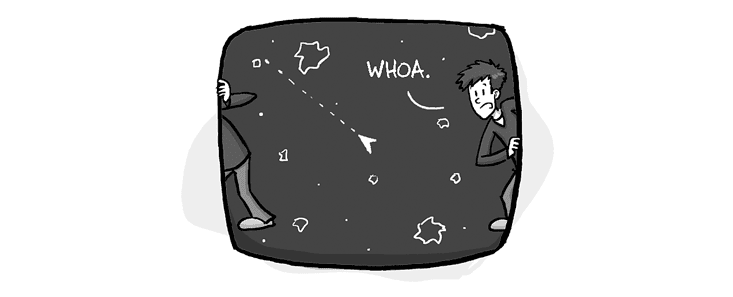
Even more intriguing is the possibility that space can be flat and still loop around itself. It would be like playing one of those video games (like Asteroids or Pac-Man) where if you move beyond the edge of the screen you simply appear on the other side. Space might be able to connect with itself in some way that we are not completely aware of yet. For example, wormholes are theoretical predictions of general relativity. In a wormhole, two different points in space that are far apart can be connected to each other. What if the edges of space are all connected together in a similar way? We have no idea.
Quantum Space
Finally, you can ask whether space is actually made up of tiny discrete bits of space, like the pixels on a TV screen, or infinitely smooth, such that there are an infinite number of places you can be between two points in space?
Scientists in ancient times might not have imagined that air is made up of tiny discrete molecules. After all, air appears to be continuous. It acts to fill any volume and it has interesting dynamical properties (like wind and weather). Yet we know that all these things we love about air (how it brushes gently against your cheek in a cool summer breeze or how it keeps us from asphyxiating) are actually the combined behavior of billions of individual air molecules, not the fundamental properties of the individual molecules themselves.
The smooth space scenario would appear to make more sense to us. After all, our experience of moving through space is that we glide through it in an easy, continuous way. We don’t jump from pixel to pixel in a jerky fashion the way a video-game character does when it moves across the screen.
Or do we?
Given our current understanding of the universe, it would actually be more
surprising if space turned out to be infinitely smooth. That’s because
we know that everything else is quantized. Matter is quantized, energy
is quantized, forces are quantized, Girl Scout cookies are quantized.
Moreover, quantum physics suggests that there might be a smallest
distance that even makes sense, which is about 10−35 meters.7
So from a quantum mechanical perspective, it would make sense if space
was quantized. But, again, we really have no idea.
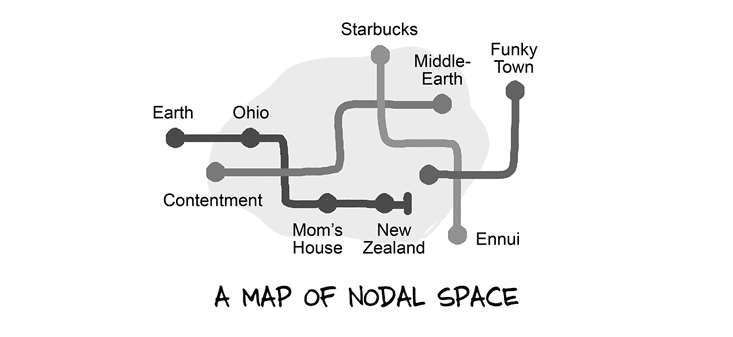
But having no idea hasn’t stopped physicists from imagining crazy possibilities! If space is quantized, that means that when we move across space we are actually jumping from small little locations to other small little locations. In this view, space is a network of connected nodes, like the stations in a subway system. Each node represents a location, and the connections between nodes represent the relationships between these locations (i.e., which one is next to which other one). This is different from the idea that space is just the relationship between matter, because these nodes of space can be empty and still exist.
Interestingly enough, these nodes would not need to sit inside a larger space or framework. They could just ... be. In this scenario, what we call space would just be the relationships between the nodes, and all the particles in the universe would just be properties of this space rather than elements in it. For example, they might be vibrational modes of these nodes.
This is not as far-fetched as it sounds. The current
theory of particles is based on quantum fields that fill all of space. A
field just means there is a number, or a value, associated with every
point in that space. In this view, particles are just excited states of
these fields. So we are not too far from this kind of theory already.
By the way, physicists love this type of idea, where something that seems fundamental to us (like space) comes out accidentally from something deeper. It gives them the sense that we have peeked behind the curtain to discover a deeper layer of reality. Some even suspect that the relationships between nodes of space are formed by the quantum entanglement of particles, but this is mathematical speculation by a bunch of overcaffeinated theorists.
The Mysteries of Space
If you have read this far and either understood it deeply or just turned your nonsense alarm to mute, then we should not hesitate to explore the craziest concept about space (yes, it gets crazier).
If space is a physical thing—not a backdrop or frame—with dynamic properties such as twists and ripples, perhaps even built out of quantized bits of space, then we have to wonder: What else can space do?
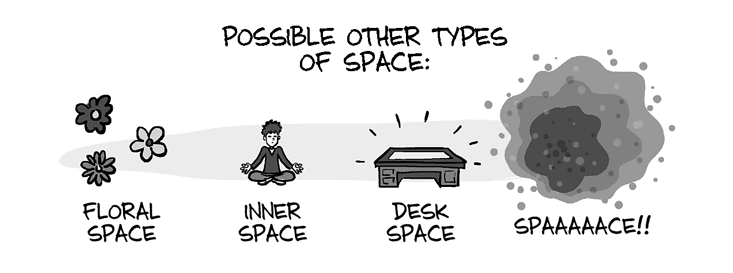
Like air, perhaps it has different states and phases. Under extreme conditions, maybe it can arrange itself in very unexpected ways or have weird unexpected properties in the same way that air behaves differently whether it’s in liquid, gas, or solid form. Perhaps the space we know and love and occupy (sometimes more than we’d like) is only one rare type of space and there are other types of space out there in the universe just waiting for us to figure out how to create and manipulate them.
The most intriguing tool we have to answer this question
is the fact that space is distorted by mass and energy. In order to
understand what space is and what it can do, our best bet is to push it
to extremes by looking carefully at places where cosmically huge masses
are squeezing and straining it: black holes. If we could explore near
black holes, we might see space shredded and chopped in ways that cause
our nonsense alarms to explode.
And the exciting thing is that we are closer than ever to being able to probe these extreme deformations of space. Whereas before we were deaf to the ripples of gravitational waves moving through the universe, we now have the ability to listen in to the cosmic events that are shaking and disturbing the goo of space. Perhaps in the near future we will understand more about the exact nature of space and get at these deep questions that are literally all around us.
So don’t space out. And save some space in your brain for the answers.
From We Have No Idea: A Guide to the Unknown Universe by Jorge Cham and Daniel Whiteson