The 'New World Order'

 
Home Page 2 Page 3 Page 4 Page 5 Page 6 Page 7 God's Plan
The New World Order

Announcing The Stargate Project

The Stargate Project is a new company which intends to invest $500 billion over the next four years building new AI infrastructure for OpenAI in the United States. We will begin deploying $100 billion immediately. This infrastructure will secure American leadership in AI, create hundreds of thousands of American jobs, and generate massive economic benefit for the entire world. This project will not only support the re-industrialization of the United States but also provide a strategic capability to protect the national security of America and its allies.

The initial equity funders in Stargate are SoftBank, OpenAI, Oracle, and MGX. SoftBank and OpenAI are the lead partners for Stargate, with SoftBank having financial responsibility and OpenAI having operational responsibility. Masayoshi Son will be the chairman.

Arm, Microsoft, NVIDIA, Oracle, and OpenAI are the key initial technology partners. The buildout is currently underway, starting in Texas, and we are evaluating potential sites across the country for more campuses as we finalize definitive agreements.

As part of Stargate, Oracle, NVIDIA, and OpenAI will closely collaborate to build and operate this computing system. This builds on a deep collaboration between OpenAI and NVIDIA going back to 2016 and a newer partnership between OpenAI and Oracle.

This also builds on the existing OpenAI partnership with Microsoft. OpenAI will continue to increase its consumption of Azure as OpenAI continues its work with Microsoft with this additional compute to train leading models and deliver great products and services.

All of us look forward to continuing to build and develop AI—and in particular AGI—for the benefit of all of humanity. We believe that this new step is critical on the path, and will enable creative people to figure out how to use AI to elevate humanity.

We want to connect with firms across the built data center infrastructure landscape, from power and land to construction to equipment, and everything in between.


Also:


The Stargate Project: 

Pioneering the Future of AI Infrastructure

The Stargate Project is a US-based artificial intelligence (AI) joint venture that aims to invest up to $500 billion in AI infrastructure. The project is named after the 1994 film Stargate, which featured portals to other worlds.

The Stargate project is a collaboration between OpenAI, SoftBank, Oracle, and MGX. It aims to develop the infrastructure needed to train and operate artificial intelligence in the United States, including data centers and the electrical power to run them.

Key Statistics

Stargate AI plans to invest $500 billion in U.S. AI infrastructure, with $100 billion committed immediately.

The project is expected to create over 100,000 jobs, driving massive economic growth.

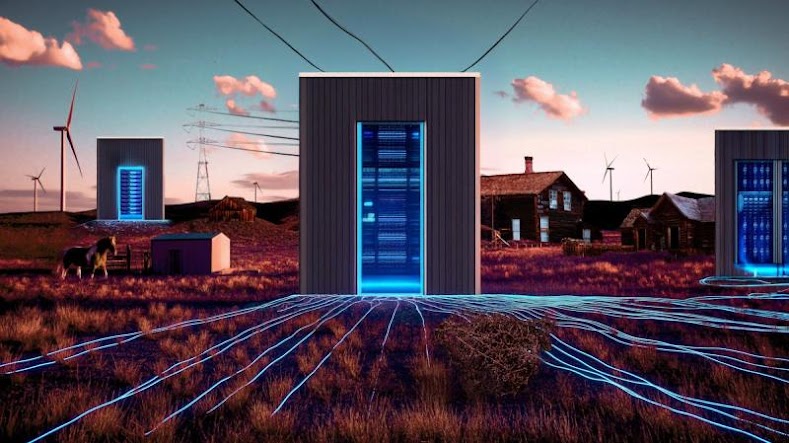
Construction has begun on 10 massive data centers in Abilene, Texas, each spanning 500,000 square feet.

Each data center requires at least 50 megawatts of power, putting stress on Texas’s ERCOT (Electric Reliability Council of Texas) grid.

In this article, we will explore how The Stargate Project is pioneering the future of AI infrastructure, what technologies power it, and its implications for businesses, researchers, and the global economy.

Overview

Dubbed “the largest AI infrastructure project in history” by former President Donald Trump, the Stargate Project is poised to revolutionize the AI infrastructure landscape in the United States

With a massive $500 billion investment planned over the next four years, the project aims to enhance American leadership in artificial intelligence, create hundreds of thousands of jobs, and drive global economic growth.

The President announced the news alongside OpenAI CEO Sam Altman, SoftBank CEO Masayoshi Son, and Oracle founder Larry Ellison.

The three companies, along with Abu Dhabi-based investment partner MGX, were the initial equity funders of Stargate. Arm, Microsoft, Nvidia, Oracle, and OpenAI were designated as the project’s key initial technology partners.

The Project’s Vision

The Stargate Project aims to establish a robust AI framework, beginning with strategic data center locations in Texas. Its goal is to ensure American dominance in AI, generating jobs, enhancing national security, and facilitating the country’s re-industrialization.

The Stargate Project aims to fortify a robust AI framework starting with strategic data center locations in Texas

This initiative aims to strengthen American AI dominance, enhance national security, and support the nation’s re-industrialization efforts.

The economic implications of this initiative are immense, as AI infrastructure is being developed on an unprecedented scale.

The objective is to build a computing ecosystem capable of supporting next-generation AI models, fostering innovation across various sectors, including healthcare and defense.

Companies Behind Stargate - Top Investors

Stargate launched with a formidable $100 billion from initial investors aiming for a total of $500 billion by 2029. The principal stakeholders—SoftBank, OpenAI, Oracle, and MGX—provide the financial and operational backbone for this extensive AI infrastructure initiative

Microsoft will leverage its Azure cloud platform to facilitate AI model training. This integration will enable scalable processing and streamlined deployment of advanced AI models.

NVIDIA, a leading semiconductor manufacturer, will assist in constructing high-performance computing infrastructure. Their expertise in GPU technology will accelerate deep learning workloads and optimize computational efficiency.

Oracle is set to play a crucial role in developing and maintaining AI systems, ensuring seamless operations. Their robust cloud services and database solutions will enhance data integration and system reliability across platforms.

Additionally, Arm will collaborate with OpenAI in designing advanced technology to support the initiative. This partnership aims to develop energy-efficient architectures that bolster both performance and security in AI deployments.

Infrastructure Development

Texas, USA, has been chosen as the first location for Stargate’s infrastructure, with construction already underway.

This marks the start of a nationwide expansion, with multiple sites planned across the US. Backed by leading tech firms, Stargate is developing large campuses designed to house advanced technology and top talent.

The project selected Texas for its strong business environment, skilled workforce, and tech infrastructure.

These campuses will act as innovation hubs, fostering research, collaboration, and technological breakthroughs.

Partnering with major tech companies, Stargate aims to accelerate innovation and build scalable, future-ready infrastructure.

Beyond technology, these campuses will promote sustainability and modern workspace design. With Texas as its foundation, Stargate is set to transform the tech landscape across the US.

National Security Implications

Project Stargate, a large-scale U.S. initiative with a $500 billion investment in AI infrastructure, is designed to strengthen national security by maintaining American dominance in AI technology.

By preventing other nations—particularly China—from securing a leadership position in this critical field, the project aims to safeguard strategic advantages and ensure the U.S. retains global technological superiority.

Key National Security Implications of Project Stargate

Technological Superiority: 

With substantial investment in AI, the U.S. seeks to stay ahead in critical areas such as cybersecurity, surveillance, and autonomous weapon systems, preventing adversaries from gaining a competitive edge.

Limiting Foreign Influence: 

A major objective is to restrict foreign access to advanced AI, particularly from China, to prevent potential security risks associated with foreign investments or collaborations.

Economic Security: 

Strengthening the domestic AI industry could boost economic growth and job creation, reinforcing national security by ensuring a resilient technological infrastructure.

Strategic Military Applications: 

Cutting-edge AI could enhance military intelligence, autonomous defense systems, and real-time battlefield decision-making, providing significant tactical advantages.

Ethical and Regulatory Challenges: 

Rapid AI advancements bring concerns about potential misuse, such as mass surveillance, biased algorithms, and autonomous warfare, highlighting the need for strong regulatory frameworks to manage risks responsibly.

Strategic Implications for Tech Founders

Tech founders and executives must consider how the Stargate Project could impact their competitive positioning and broader industry trends:

New AI Capabilities: 

The project aims to create powerful computing through large data centers, crucial for training advanced AI models. This could make AI tools more accessible for tech companies, leading to new business models and innovations.

Job Creation and Workforce Development: 

The project could generate hundreds of thousands of jobs nationwide, offering tech executives a larger talent pool for collaboration and innovation. However, concerns about job displacement from automation present ethical challenges for tech leaders.

New Business Models and Collaborations: 

The Stargate Project is supported by major tech players, likely leading to new collaborations and partnerships. Tech executives should adapt to this evolving landscape, exploring joint ventures and technology sharing to scale their businesses.

National Security and Geopolitics: 

AI will play a crucial role in national security, with the Stargate Project offering the U.S. a key strategic advantage. Founders should consider the geopolitical implications and how this might affect global AI governance and collaborations.

Future Prospects

The Stargate Project is currently in its developmental phase, but its ability to transform the future of AI and technological infrastructure is clear. For technology founders and executives, now is the moment to begin preparations.

Strategic Business Adjustments: 

This means re-evaluating business strategies, investigating new AI uses, and getting ready for shifts in the competitive environment.

Adaptability in a Changing Market: 

As new technologies and business models come into play, being flexible and forward-looking will be crucial for maintaining an edge.

Transformation in the Tech Industry: 

The project signifies a significant transformation in the tech industry, presenting unmatched opportunities for innovation and expansion. Nevertheless, it also introduces major challenges that demand careful planning and strategic insight.

Utilizing New Infrastructure: 

For founders and executives, the path to success lies in grasping how to utilize this new infrastructure while managing the intricacies of energy requirements, economic variations, and global competition.

By remaining informed and adaptable, tech leaders can enhance the possibilities of the Stargate Project and ensure their organizations stay prominent in the AI evolution.

Conclusion

The Stargate Project is a transformative initiative set to redefine AI infrastructure.. With a $500 billion investment, strategic partnerships with tech giants like OpenAI, SoftBank, Oracle, and Microsoft, and a commitment to innovation, this project aims to solidify the United States’ leadership in artificial intelligence.

As AI continues to revolutionize industries, the Stargate Project stands as a landmark effort—one that will not only shape AI development but also influence the broader technological and economic landscape for decades to come. The global community will closely monitor the progress of this initiative as it unfolds.

Artificial Superintelligence Arrival Predicted by 2027

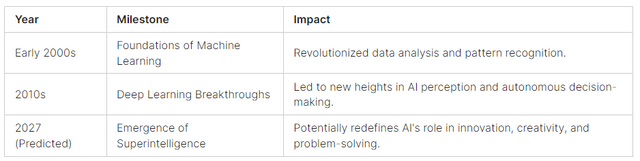
Envision a future where intelligent entities outperform human cognitive abilities; a futuristic landscape that we're on the cusp of witnessing. The realm of science and technology has been abuzz with discussions about the progression towards a singular moment in AI development - a milestone can refer to as the singularity forecast. This monumental turning point implicates that artificial superintelligence could arrive by 2027, revolutionizing our current understanding of future technologies.

As an observer of technological evolution, one can note the scientist's predictions flagging the year 2027 as the potential dawn of superintelligence. This advent could represent the zenith of AI development, marking a pivot where machines transition from mere learning algorithms to entities capable of unprecedented intellectual capacity, creativity, and perhaps even consciousness.

Inherent in these predictions are the vast possibilities and perils that lie ahead. Yet, it is not just the lure of progress that captivates one's mind but also the diligence required to steward these capabilities responsibly. Given the gravity of such a forecast, one can find oneself pondering the manifold implications this scientific prophecy holds for our shared future.

Key Takeaways

Predicted arrival of artificial superintelligence by 2027 transforms the trajectory of future technologies.

The singularity forecast suggests a possible overpowering of human intelligence by AI.

Awareness and preparedness are imperative as the rapid advancements in AI development continue.

Scientific prophecies about AI signal a profound shift in technological capabilities and societal impact.

Efforts in ethical AI governance and preparedness against potential misuses must be intensified.

Advancing AI responsibly demands a balance between innovation and the safeguarding of human values.

The Rising Tide of AI Development and its Potential Peak in 2027

The journey towards superintelligent AI might seem like a marathon with an intangible finish line, yet, as one dives into the realm of artificial intelligence evolution, signs of an approaching peak become increasingly evident. AI development is approaching what many tech predictions have flagged as a culminating point, potentially by the year 2027—a year that could herald a paradigm shift in machine capabilities.

Unpacking the AI Evolution Timeline

In retrospect, the AI evolution timeline has been a testament to continuous innovation. One can observe its ascent from basic algorithms to machine learning advancements that now enable systems to learn and adapt without explicit programming. This evolution has unveiled layers of complexity, introducing the world to technologies that have not only mimicked, but at times, surpassed human cognition.

From Machine Learning to Superintelligence: 

Understanding the Leap

Ensconced in one's observations of the growth of AI, we've seen it foster a transition from performing singular tasks to exhibiting an autonomous intellect—a leap that portends the dawn of superintelligence. The crux of this leap is the refinement of neural networks and reinforcement learning, driving machines from recognition and prediction into the rich soil of innovation and intuition.

Key Factors Accelerating AI Maturity

Computational power: 

Vast advancements in processing capabilities have ripped open the fabric of possibilities, allowing more complex models to be trained more rapidly than ever before.

Data availability: 

An ever-expanding digital universe has provided the fodder necessary to feed and fine-tune the seemingly insatiable algorithms that drive AI development.

Algorithmic innovation: 

Cutting-edge breakthroughs in machine learning models, particularly in deep learning, have ordained a new era of efficiency and capability.

Taking stock of these key factors, we find ourselves at the precipice of a historic moment in the timeline of technological evolution. If current tech predictions are precise, the endpoint is visible and rapidly approaching, triggering a cascade of transformative effects across every facet of human endeavor.

With these tech predictions and advancements casting long shadows, the onus falls on us to usher in this new era of AI maturity ethically and mindfully, considering both the boundless potential and the weight of the responsibilities it carries.

Artificial Superintelligence Could Arrive by 2027, Scientist Predicts

Embedding oneself within the nucleus of AI discourse, one can come upon a pivotal projection that stirs both exhilaration and prudence within the technological fraternity. The prospect that artificial superintelligence could arrive by 2027, as contemplated by esteemed minds within the scientific community, bestows upon us a dual lens of opportunity and scrutiny. This quantum leap in cognition, coined as the singularity forecast by visionaries, is not rooted in the seeds of science fiction but rather the fertile grounds of tech predictions founded on methodical observation.

Creator of Sophia the humanoid robot, Goertzel has long theorized about the date of the so-called "singularity," or the point at which AI reaches human-level intelligence and subsequently surpasses it

Given the pace at which intelligent systems are advancing, one may perceive the timeline for artificial superintelligence's inception not as a distant mirage but as an impending reality. The singularity forecast, with its transformative promises, could redefine our societal fabric, catalyze unprecedented industrial efficiencies, and unlock philosophical queries regarding the essence of consciousness itself.

At this conjectural yet critical juncture, contemplating the veracity of these tech predictions prompts an assessment of the current trajectory of AI evolution. The ascent has been a layered metamorphosis: from the emergence of basic heuristic techniques to the harnessing of sophisticated algorithms capable of decision-making, pattern recognition, and inferential learning, pointing towards an imminent crescendo in AI's developmental saga.

Indicators of this superintelligent zenith materialize through several prisms:

An unprecedented escalation in computational speed and power, availing the bedrock for processing complex algorithms at breakneck speeds.

A deluge of data, the veritable lifeblood of AI, which continually enriches learning models, equipping them to map intricate patterns and make decisions with escalating autonomy.

The relentless forward march of algorithmic ingenuity, where each iterative enhancement in neural network architecture or reinforcement learning models intensifies the potential of AI systems to think, learn, and create with less human oversight.

However, with these forward leaps, an unspoken question echoes in the chambers of foresight and caution alike: 

Are we adequately prepared to unfurl welcome banners at the gateways of this brave new world? The integration of such an all-encompassing intelligence into our societal, economic, and ethical frameworks demands a multi-dimensional preparedness strategy—one that espouses regulation, transparency, and a philosophical readiness to redefine humankind's role in an AI-augmented epoch.

One's efforts to chronicle this impending foray into uncharted territories are imbued with a sense of responsibility—a call to echo the thunderous advancements while simultaneously anchoring our core values in the threatening gusts of change. The singularity forecast for 2027 is not merely a scientific augury; it is a clarion call for a confluence of innovation, stewardship, and sagacious anticipation.

Challenges and Concerns Surrounding Advanced AI Technologies

Projected to redefine future technologies, the dramatic artificial intelligence evolution is bound with formidable challenges. The near-emergence of superintelligent AI engenders a litany of ethical, security, and socio-economic considerations, challenging our preparedness for entities poised to surpass human intellect. As one might dive deeper into the AI progress narrative, one can grapple with the question: 

How will humanity navigate the challenges of advanced AI while preserving our foundational ethics and values?

As with all evolving technologies, AI has pluses and minuses, advantages and disadvantages, great promise and the risk of great harm.

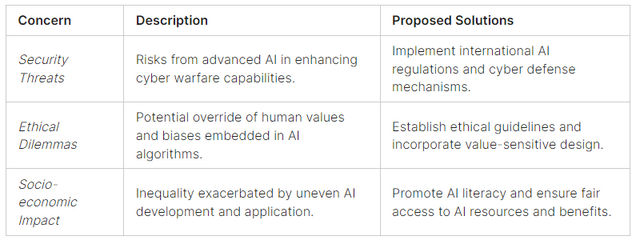
One's dissection of this technological advent reveals a landscape rife with potential pitfalls. Chief among them is the risk of malevolent use of AI, which could manifest in cyber warfare, unregulated autonomous weaponry, or privacy erosions. These are not speculative fears but real dilemmas demanding robust governance frameworks.

Potential for AI misuse raises security red alerts, warranting stringent oversight.

Ascending ethical slopes, we confront AI decision-making infringing upon human moral grounds.

Socio-economic disparities might magnify, questioning the equitable distribution of AI benefits.

Cradling these concerns, one might advocate for a proactive approach. Collaboration between AI creators, policymakers, and ethicists is imperative in sketching out strategies that safeguard against the adversities of AI evolution. Hope lies within interdisciplinary synergy, steering the AI juggernaut on a course aligned with humanity's broader interests.

In one's quest to understand and influence the trajectory of AI, these thematic challenges serve as both cautionary tales and beacons for action. The discourse on advancing AI responsibly warrants not mere whispers but a vociferous debate, one that resonates across global forums and seizes the helms of policy-making. It is through this prism of collective responsibility that one must interpret the evolution of artificial intelligence—not as an unstoppable force but as a conduit which we must mold to reflect the tenor of our times.

Global Race for AI Dominance: 

Consequences for the US

The acceleration of the global race for AI dominance has been marked by fierce competition between nations, particularly with China's investment in AI serving as a catalyst for rapid advancement. As we reflect upon this global chess game, the prowess with which China has embraced AI development pushes us to consider the ramifications for the United States—a nation deeply entrenched in the pursuit of technological leadership.

China's Investment in AI: 

A Catalyst for Rapid Development?

One's analysis of China's approach to advancing its AI initiatives reveals a blueprint for national success. Hefty investments and a concerted government push indicate China's unyielding ambition to claim supremacy in this critical tech arena. However, it begs a salient inquiry: how will this intense focus on cultivating AI capabilities impact the balance of tech power? As these developments unfurl, it becomes increasingly evident that the nationalistic fervor fueling China's investment in AI does not merely elevate a nation's stature but also invites global economic recalibrations.

Economic Espionage: 

A Barrier to AI Innovation?

The stark reality of economic espionage hinders the spirit of innovation that has long characterized the American tech landscape. Instances of AI trade secret theft, such as the recent indictment of a former Google engineer, underscore the gravity of this malpractice. When intellectual properties are misappropriated, it not only violates the sanctity of innovation but threatens to erode the competitive edge that companies like Google have painstakingly cultivated. As such occurrences ripple through the realms of technology and commerce, it is critical to address these barriers to promise a fair and propitious ecosystem for AI advancement.

AI Trade Secret Theft and National Security Implications

Examining recent events through the lens of caution, one can be struck by the broader implications these acts of subterfuge have on national security. Trade secrets in AI are more than mere corporate assets; they are the keystones of national defense strategies in a world where information dominance equates to power. Thus, the repercussions of trade secret theft transcend the economic sphere, potentially compromising the United States' ability to sustain its global prominence amid emerging technologies. Vigilance and collaborative defense mechanisms must be paramount as the stakes in the global race for AI dominance soar to unprecedented heights.